Training requirements
As part of the national child safety reforms, mandatory training requirements under sections 162A and 162B of the National Law commenced on 27 February 2026. These new training requirements supersede the Queensland Government protocol that was previously in place in relation to child protection.
Child protection training—s162A of the National Law
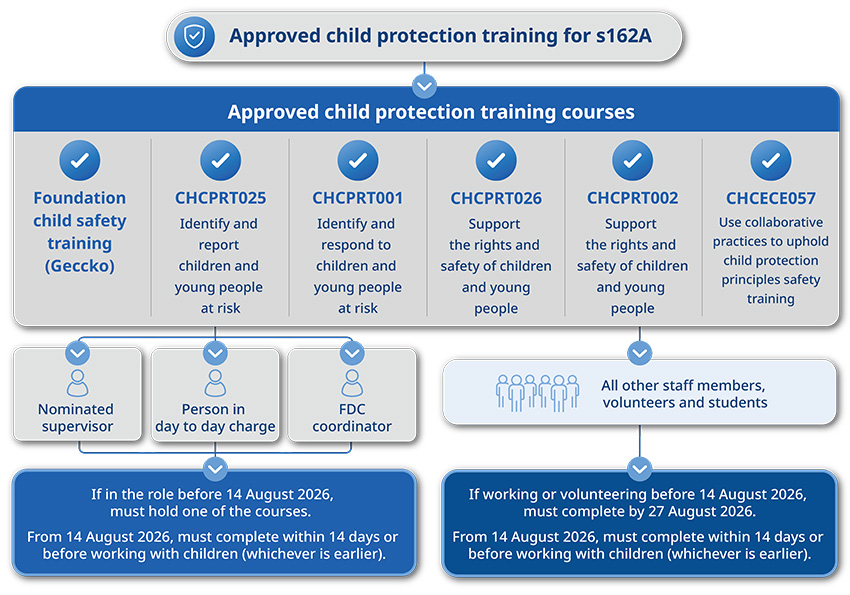
From 27 February 2026, nominated supervisors, persons in day-to-day charge, staff members and volunteers (including students) must complete approved child protection training.
The approved child protection training courses are:
- Foundations of child safety training
- CHCPRT025—Identify and report children and young people at risk
- CHCPRT001—Identify and respond to children and young people at risk
- CHCPRT026—Support the rights and safety of children and young people
- CHCPRT002—Support the rights and safety of children and young people
- CHCECE057—Use collaborative practices to uphold child protection principles
Further information on these courses is available in this list of Queensland's approved child protection training (PDF, 112KB) and on the ACECQA website.
Existing workers and volunteers before 14 August 2026
Nominated supervisors, persons in day-to-day charge and family day care co-ordinators:
- must hold
one of the approved child protection training courses from 27 February 2026.
Staff members or volunteers (including students) in any other role:
- have 6 months from 27 February 2026 to complete
one of the approved child protection training courses (i.e. complete by 27 August 2026).
New workers and volunteers after 27 August 2026
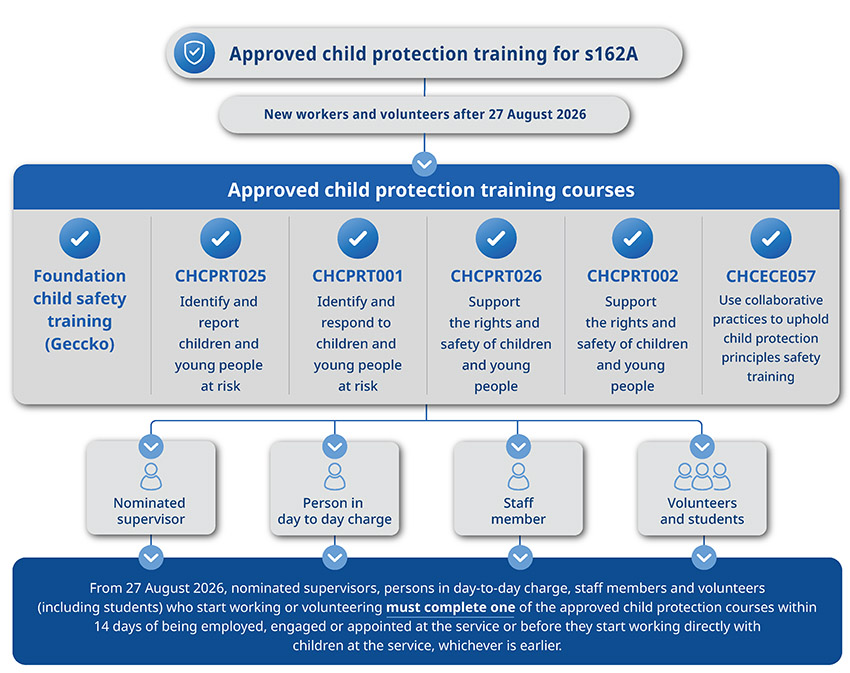
Any new nominated supervisors, persons in day-to-day charge, staff members or volunteers (including students) who start working or volunteering after 27 August 2026 must complete
one of the approved child protection courses within 14 days of being employed, engaged or appointed at the service or before they start working directly with children at the service, whichever is earlier.
Child safety training—s162B of the National Law
Foundation child safety training
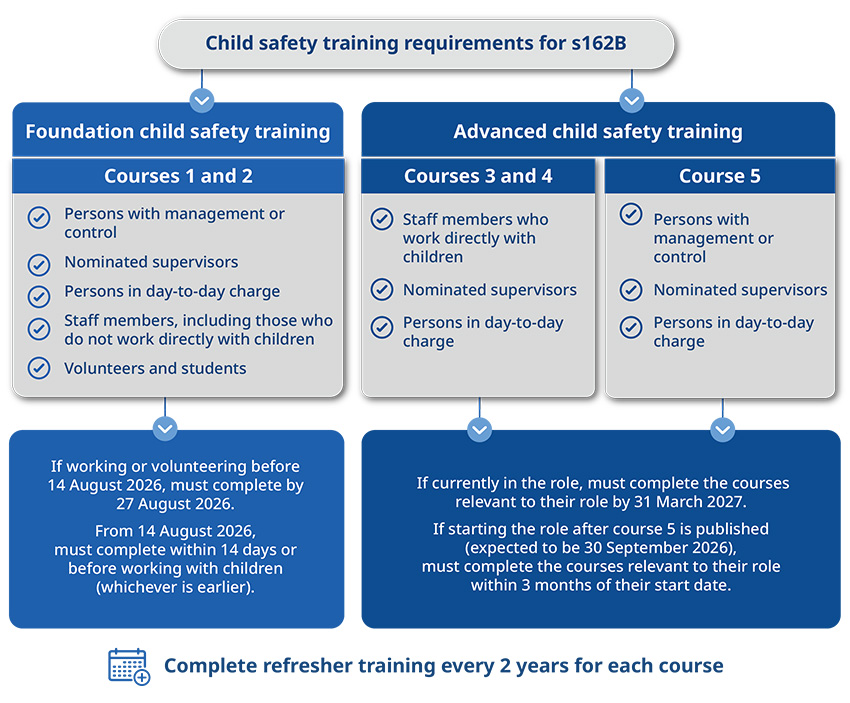
From 27 February 2026, people in the following roles must complete mandatory
foundation child safety training (foundation training) to comply with
s162B:
- persons with management or control
- nominated supervisors
- persons in day-to-day charge
- staff members
- volunteers and students.
Geccko provides free foundation training comprising of 2 courses. Both courses must be completed to satisfy the mandatory training requirement:
- Course 1: Understanding child safety
- Course 2: Understanding and identifying child abuse and neglect.
People who began working or volunteering:
- before 14 August 2026 must complete the foundation training by 27 August 2026.
- on or after 14 August 2026 must complete the foundation training within 14 days or before they start working directly with children at the service, whichever is earlier.
Refresher training must be completed every 2 years.
Advanced child safety training
From 31 July 2026, people in specific roles must complete mandatory
advanced child safety training (advanced training) to comply with
s162B.
Geccko provides a free advanced training package comprising of 3 courses:
- Course 3: Creating child safe cultures through everyday practice—available 31 July 2026
- Course 4: Responding to safeguarding concerns—available 31 July 2026
- Course 5: Leading and governing child safety—available from 30 September 2026.
This training is tailored to specific roles:
-
staff members who work directly with children must complete courses 3 and 4
-
nominated supervisors must complete courses 3, 4 and 5
-
persons in day-to-day charge must complete courses, 3, 4 and 5
-
persons with management or control (PMC) must complete course 5 only.
People who began working in the roles above:
- before 30 September 2026 must complete the advanced training required for their role by 31 March 2027.
- on or after 30 September 2026 must complete the advanced training required for their role within 3 months of their start date.
Refresher training must be completed every 2 years.
Mandatory reporting
Education and care staff
One of the most serious duties that education and care staff have is the obligation to act when they reasonably suspect that a child is in need of protection from abuse or neglect. All early childhood education and care professionals are mandatory reporters under the
Child Protection Act 1999, and are therefore legally required to report to Child Safety where they reasonably suspect that a child:
- has suffered, is suffering, or is at risk of suffering significant harm caused by sexual or physical abuse
- may not have a parent who is willing and able to protect them from harm.
To find out more, visit the
mandatory reporting page on the Department of Families, Seniors, Disability Services and Child Safety website.
All adults
It is an offence for any adult to fail to report sexual offending against a child by another adult to police, unless they have a reasonable excuse.
To find out more, visit the
failing to report sexual offences against children page on the Queensland Government website.
Offence to not protect children from sexual offenders
Persons in position of power or responsibility
It is an offence to fail to take steps to protect children from sexual offenders.
This offence requires a person in a position of power or responsibility within an institution, which includes education and care services, to reduce or remove a known risk of sexual offending against a child by an adult associated with an institution.
To find out more, visit the
failing to protect children from sexual offences page on the Queensland Government website.
Working with children checks
Blue Card Services administers the blue card program, Queensland's working with children check.
Individuals working in education and care service premises where children are present must have a blue card prior to starting work. This includes permanent staff providing education and care, and also other employees and volunteers at the service, tradespeople, supervisors of student placements, students on placements (even when under 18 years of age), and adult residents of family day care services.
Access an overview of
how the blue card system works, including what background information is checked and how compliance is monitored daily.
Blue Card Services issues negative notices to individuals who, in the best interests of children, should not hold a blue card. Approved providers must not start or continue a negative notice holder in employment.
Blue Card Services notifies the Regulatory Authority when there is a change in an individual’s blue card status, so approved providers in Queensland are
not required to also notify the Regulatory Authority of this status change under
Regulation 176C.
Awareness of child protection obligations
Under regulation 84, approved providers must ensure that nominated supervisors, staff members and volunteers (including students) are advised of the existence and application of current child protection laws and their obligations under them.
The
guide to the NQF sets out a range of ways that an approved provider may wish to fulfil their obligations under regulation 84, including regular refresher training, in-house workshops, online training, distributing information to staff, or discussing obligations.
Roles and responsibilities to identify and respond to the risk of abuse are outlined in National Quality Standard (NQS) element
2.2.3 Child Protection.
Adequate supervision
Approved providers, nominated supervisors and family day care (FDC) educators must ensure children are adequately supervised at all times (section 165). Educator-to-child ratios alone do not by themselves achieve
adequate supervision; services must be sufficiently staffed to enable adequate supervision at all times.
Building design also supports adequate supervision. The NQF requires approved providers to ensure that premises, including toilets and nappy change facilities, are designed and maintained to facilitate supervision of children while maintaining their rights and dignity (regulation 115).
Approved providers, nominated supervisors and FDC educators all must ensure that nobody remains on the education and care premises unless they are an authorised person—this means they hold a blue card or exemption card—or are under the direct supervision of an educator or other staff member (section 170).
The policies and procedures for
providing a child-safe environment (PDF, 254KB) requires details of how the service promotes a culture of child safety and wellbeing, and the safe use of online environments in the service.
Read more about
adequate supervision.
Child protection in family day care
The NQF requires policies and procedures are in place for the
assessment of FDC educators, educator assistants and adult residents of FDC residences (PDF, 220KB) to ensure they are fit and proper (regulation 169).
Additionally, approved providers of FDC services must require FDC educators to notify them of any new adult residents and any circumstances related to adult residents and educator assistants that may affect whether the person is fit and proper to be in the company of children (regulation 164).
The FDC educator must make these notifications to the approved provider (regulation 164). This requirement was
further strengthened on 1 October 2023 (PDF, 893KB).