The 6 stages of complaints management
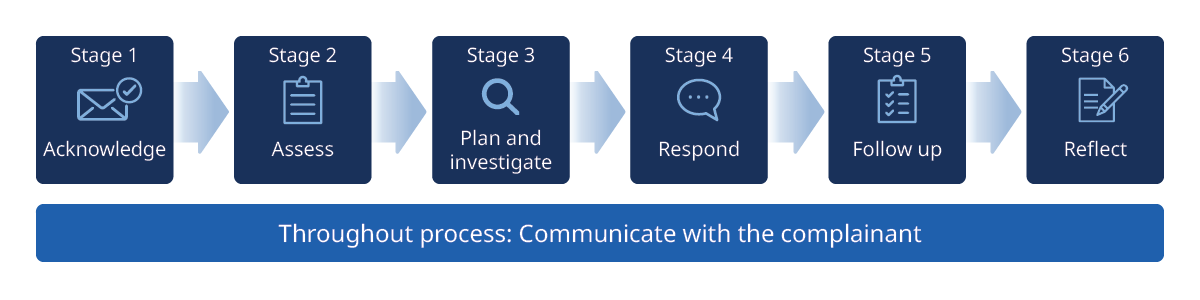
The 6 stages of complaints management are based on the Australian/New Zealand standard—guidelines for complaints management in organisations and on best practice complaints management approaches for Australian workplaces. The information below is designed for service staff involved in any stage of complaints management and provides practical guidance for translating theory into action. Where relevant, it also references the child safe culture guide developed by Australian Children's Education and Care Quality Authority (ACECQA).
Open, regular communication is vital in effective complaints management. You should maintain regular contact with the complainant throughout the process (particularly when the process takes longer than first advised). For more information about effective communications with complainants (including children), visit the
communicating with complainants resource.
Complaints management needs to be child-friendly. Children should have the right to voice their concerns and know they will be listened to and treated with respect. For specific information about handling complaints from children and young people, visit the
National Office for Child Safety website and the
ACECQA child safe culture guide.
Stage 1: Acknowledge

Acknowledging the complaint quickly demonstrates to the complainant that you are taking the matter seriously.
Your acknowledgement should:
- thank the complainant for bringing the problem to your attention
- outline the complaint process
- invite the complainant, and any representatives if they have them, to participate in the resolution process (if appropriate)
- provide contact details including the name of the contact person dealing with the complaint
- reassure that confidentiality will be respected during the process
- give an estimate of how long it is likely to take to resolve the complaint and when the contact person will next contact the complainant.
Refer to your service's complaints management policy and procedures for guidance on whether to acknowledge in writing or verbally, as well as how to document the details of the complaint.
Stage 2: Assess

An accurate initial assessment of a complaint is essential for deciding the appropriate course of action.
Your assessment should involve:
- confirming the scope of the complaint (if unclear)
- collecting relevant information from the complainant, including their name, contact details, details of concerns, dates of incidents, people involved, witnesses and desired outcome from the complaint
- confirming whether the complainant agrees to you raising their issue with others if necessary (while respecting their privacy and dignity)
- confirming if any notifications are required under the NQF, ECS Act, or other legislation (e.g. mandatory reporting, Reportable Conduct Scheme)
- determining the priority of the complaint
- determining the most appropriate pathway to resolution.
To assist, ACECQA has developed an
incident response template (PDF, 971KB) as part of their child safe culture guide, for use when responding to a complaint or concern about the safety of a child or children, and/or when a disclosure is made by or about a child at the service.
Refer to your service's policy and procedures for any service-specific information on assessing a complaint, including resolution of straightforward complaints and escalation of more serious matters. For information on who to notify for different types of complaints, visit the links in the
reporting complaints section at the bottom of this page.
Complaints that are straightforward with low risk to children can often be resolved on first contact by implementing a quick fix and ensuring the complainant is satisfied. More complex complaints may require an investigation or enquiries to other organisations.
Some problems might not be easy to resolve, or the complainant may seek an inappropriate or disproportionate outcome. It's important to explain why a request cannot be met, and it's equally important to offer an alternative solution, if possible.
Stage 3: Plan and investigate (if required)

Not all complaints will require an investigation. For those that do, an investigation will allow you to gather relevant evidence to substantiate or disprove the complaint, identify non-compliance with the legislation, identify actions to resolve the complaint, and identify areas for improvement to minimise the risk of the issue reoccurring in the future.
Preparing a written investigation plan can help you focus your attention and ensure you do not overlook any important matters.
Your plan should include:
- the concerns to investigate
- the resolution the complainant is seeking and whether the service can provide it
- the possible source of and types of information to gather
- the people involved (e.g. complainants, staff, witnesses)
- an estimate of the time it will take to resolve the complaint
- any special considerations that apply (e.g. if there is sensitive or confidential information involved and how to store this securely).
The amount of detail in your plan should reflect the complexity and seriousness of the complaint. It should also be flexible in case circumstances change or new information becomes available.
You should follow the principles of fair investigation:
-
Impartiality—approach each complaint with an open mind and ensure findings are objective.
-
Confidentiality—respect the confidentiality of the complainant and child (if relevant), and share information on a 'need to know' basis only.
-
Transparency—tell the complainant about the steps in the complaint process and maintain regular contact with all parties involved.
-
Timeliness—conduct the investigation in a timely manner.
-
Standing—provide all stakeholders (including the complainant) with an opportunity to present their point of view, including on information and claims from other sources.
Keep written records of any information or findings uncovered during the investigation. It's reasonable and good practice to ask complainants to assist by providing any documentation they may have that relates to the complaint.
Stage 4: Respond

Clearly communicating the outcome of a complaint to all parties is essential for transparency, honesty and fairness. If appropriate, an apology in the response to the complainant can demonstrate empathy and improve the chances of positively enhancing their relationship with the service.
Your responses should include:
- an apology if appropriate
- any decisions you have made and why
- actions the service has taken so the issue that caused the complaint will not be repeated
- anything you were not able to resolve and why
- any claims by the complainant that were not accepted by the parties implicated
- avenues for providing feedback.
Refer to your service's policy and procedures for how to communicate the outcome. A verbal explanation may be appropriate for straightforward complaints that are easily resolved. A written explanation is suitable for serious, complex or disputed matters. It may be appropriate to talk with the complainant first and to let them know that they will receive a more detailed written explanation.
If the complaint was notified to the RA, the RA may contact the complainant or other families at the service in the course of an investigation, including to inform of the outcome.
Stage 5: Follow up

Following up with complainants to gather feedback on how their complaint was handled and resolved fosters confidence in the service and is part of open disclosure and transparent practice.
If a complainant is not happy with the outcome, inform them of available alternatives, including external complaint mechanisms such as making a complaint to the RA (when the matter is
in scope), other agencies, or advocacy services. Your service should also provide the ability to have someone who has not been previously involved in the complaint to review it.
Mediation of an unresolved dispute between a complainant and a service provider is another option. A mediator can help clarify matters, provide an impartial perspective and propose solutions that both parties can agree to.
All feedback, whether positive or negative, should be recorded to inform continuous improvement at the service.
Stage 6: Reflect

Reflecting on complaints is a critical component of continuous quality improvement.
Complaints can provide intelligence about many aspects of the service, including where expectations of parents or other complainants have not been met, or where something is not working well. Looking at your service's record of complaints and feedback—both positive and negative—can show patterns and trends and provide opportunities to improve practice, policies and procedures. If there are recurring problems, analysing complaints can help pinpoint where the root cause may lie.
Complaints might also point to issues or problems to be considered in your service's QIP (e.g. a need to improve recordkeeping, proactively communicate with families about compliance and quality, or provide better training or support for staff).
Approved providers and nominated supervisors are responsible for systemic improvements under the legislation, but contributions from educators and other staff are essential for continuous improvement. Everyone should be given opportunities to assist with trend and pattern analysis, share observations, and find and own the solutions. Regular team discussions about complaints will also support a blame-free, resolution-focused complaints culture in your service.
Visit the ACECQA website for
questions to guide reflective practice in relation to complaints and
using complaints to support continuous quality improvement (PDF, 171KB).
How service leaders can support staff
You can support service staff to handle complaints confidently and professionally by upskilling in areas such as interpersonal communication, active and reflective listening, conflict resolution, mediation and consulting with complainants and children attending the service (where appropriate). Practical strategies include:
- a good orientation program when new staff join the service
- providing staff with professional training
- introducing a buddy system to help new or existing staff members learn new complaints management skills
- sharing ideas with other approved providers, nominated supervisors, educators and other staff nearby by participating in network meetings
- getting involved with an education and care peak body.
Reporting complaints
Approved providers and staff at services approved under the NQF or ECS Act have a range of reporting requirements relating to complaints they may receive. You should familiarise yourself with the content on the following pages on our website.
Legislation and resources
Familiarise yourself with complaints requirements under the NQF or ECS Act:
Additional resources
Learn more about complaints management in education and care services:
Source: Aged Care Quality and Safety Commission, 2025, 'Better practice guide to complaints handling in aged care services', Australian Government, accessed August 2026.