Data is a collection of information gathered by observation, questioning or measurement, to be considered, analysed and used to help with decision-making. Teachers and educators routinely collect data to support children's learning, and it is helpful to use data that is already available from both informal and formal sources.
In
Step 1 of Kindy Uplift planning, services should collect data at a child, teacher and educator, service and community level, to use as evidence to identify educational needs and strengths of the service and make informed decisions in
Step 2 and 3. Goals should be identified through data analysis, which will lead to your selection of relevant priority areas and applicable funding expenses.
Step 1 can be recorded in conjunction with
Step 2 under column Issue identified during self-assessment in the
Kindy Uplift 2026—planning QIP addendum template.
Data source categories
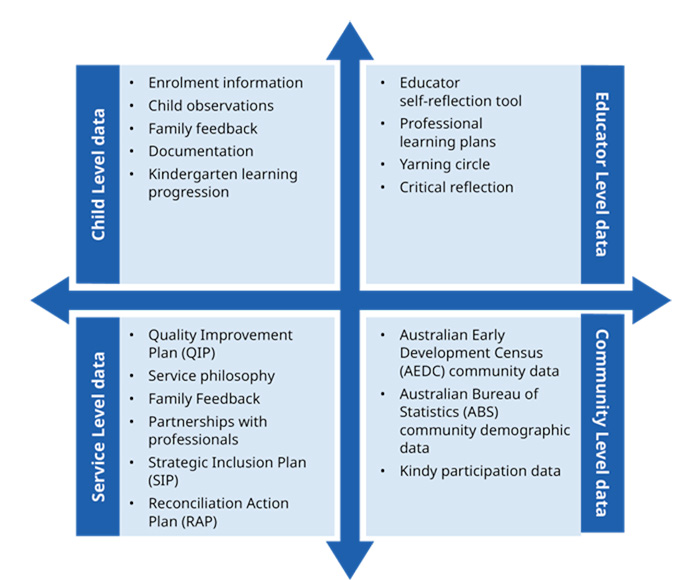
Child level data
- Enrolment information
- Child observations
- Family feedback
- Documentation
- Kindergarten learning progression
Educator level data
- Educator self-reflection tool
- Professional learning plans
- Yarning circle
- Critical reflection
Service level data
- QIP
- Service philosophy
- Family feedback
- Partnerships with professionals
- Strategic inclusion plan (SIP)
- Reconciliation action plan (RAP)
Community level data
- Australian Early Development Census (AEDC) community data
- Australian Bureau of Statistics (ABS)
- Kindy participation data
Child-level data
Critical reflection of child-level data (such as documented observations of children) offers insights to support children's learning progress and informs practice. Families as a child's first teacher, can provide valuable insights about children's learning and development strengths and needs, when engaged in planning for their child's learning. Child-level data is vital in order to identify effective strategies that can be applied to improve outcomes for learning and development.
Teacher and educator-level data
Analysis of teacher and educator-level data considers the team's capabilities in responding to children's educational and developmental needs. This process allows for an examination of their confidence in implementing the Early Years Learning Framework V2.0; principles for embedding Aboriginal and Torres Strait Islander perspectives into practice; data which identifies areas of Teacher and Educator pedagogy and practice that could be addressed with additional support, or capability development to ensure all children are included and can progress in the learning program.
Service-level data
By considering service-level data, services can make informed decisions for Kindy Uplift expenditure to enhance overall quality and support continuous improvement within their service. Alignment and integration with all other service-level documents is critical and enables Kindy Uplift planning to recognise the holistic, integrated and interconnected approach to learning and teaching.
Community-level data
Community-level data helps services understand factors influencing learning, development, inclusion and participation in kindy. By critically reflecting on insights from community partners, data like the Australian Early Development Census (AEDC) or Australian Bureau of Statistics—Statistical Areas Level 2 (SA2) data reveals key information about children's development, cultural diversity and conditions that create educational advantages within communities. Analysis of this information enables services to identify educational trends and tailor their Kindy Uplift planning effectively. Kindy Uplift services may also reflect on the strength and depth of their own partnerships within the community, the cultural connections they have established and connections to Country.
Supporting resource